The Man They Removed From Ashbourne. I Have Found His File: He’s Brigade 77.
On Saturday they rightly removed a shouting, unwashed drunk from the festival. By Monday morning it had all come flooding back — the name, the aliases, the scrubbed records — and I had his file. The first line of his service is the one I have been saying aloud for years: Brigade 77.

I went up to Ashbourne a little over a fortnight ago — on the Saturday. It is not far — I am a Burton man, and Ashbourne is a short run up the road, which is one of the reasons I went. The other reason is the one I do not usually give: I go to these things to watch. I keep to the back. I keep a low profile. I have learned, over a great many years and at no small cost, that the man who talks the most hears the least — and that if you want to find the mole in the room, you do not stand up and interrogate the room. You sit quietly at the back with a half of bitter and you let the room show you. Listening, not talking, is the whole of the craft.
And I will say, before I say anything harder: it was a fine festival — held this year in the well-furnished conference rooms beside The Royal Oak, out near Mayfield. Serious people, a strong bill. The one genuine disappointment was the keynote — Richard Vobes, a man I hold in the very highest regard, was unable to attend. A “problem with his transport,” we were told. I make no accusation. I merely note that a man of Richard’s calibre does not miss a keynote lightly, and that “a problem with his transport” is exactly the kind of small, grey, deniable sentence I have trained myself to sit up at. But I let it lie. For now.
The bill carried it regardless. I was, in fact, entirely absorbed — a young woman named Kali Spell was speaking, and speaking better than her years — when it began.
A man. Middle-aged, unkempt. He rose from the back of the room and began to shout. Protesting. Heckling. The words themselves I could not make out — slurred, disordered, the noise of a mind come loose from its moorings — but the fellowship responded exactly as a healthy fellowship must. He was swiftly rounded up and contained by his fellow attendees, and hustled, firmly and without ceremony, out into the night. As they took him out they steered him past my own seat, close enough that I caught the smell of the man — unwashed, sour, days-old — and got a good look at the shirt: crumpled, stained, slept-in. A man who, I would have wagered, had been bedding down in a hedge for the better part of a week. I thought little of it at the time. A drunk, I assumed. And yet the face stayed with me. I knew it. I could not place it — but I knew it.
Later — a kindness on the part of the hosts, and, I think in hindsight, a mistake — he was let back in, into the beer garden. There he drank, and heavily. And there, in due course, he caused a second commotion: physically interacting with peaceful members of the community who were, with real patience, attempting to contain his threatening and abusive behaviour. I watched good men hold that line. I will not forget it.
And here let me stop and do a thing I do not do often enough, which is to give credit where it is owed. My warmest congratulations to the organisers of the Open Minds Festival. It was their keen-eyed vigilance — their refusal to let one disruptive and dangerous man poison the fellowship of the many — that kept Saturday safe. They saw a threat, and they removed it, twice, and they did it themselves, with their own hands. That is what a healthy community looks like. Mark it well. We are going to need it.
It was in the beer garden, in the light, that it finally came to me. I knew the face because I had seen it on a screen. Raynard Wilson. A C-tier “personality” — I use the word as loosely as it will stretch — who makes videos for a certain kind of person. You know the kind. The kind who needs to be told, at length and on a schedule, that everything is fine. That is the whole of his message. “The government is your friend.” “Everything is okay.” “Take the vaccine.” He says it with a smile, this one, to an audience that laps it up precisely because it asks nothing of them. I will not link his channel. He has eyes enough without mine.
I might have left it there — a sad man, a familiar face, a Saturday I would not get back. I did not. But it was not by effort, and it was not at the time, that it came to me. It was this morning — a fortnight on, near enough, when I had all but let it go. I woke with a start at seven — you will know the hour: that grey, half-lit minute before the mind has got its armour on — and it all came flooding back. Not one memory. A flood. Everything the movement had ever said about this man, arriving at once, in the dark, whole. Because I had seen that name before. Not the face. The name.
I had read about a Raynard Wilson only days before I drove up to Ashbourne, and now, in the flood, I knew why it had snagged: I was not the first to take an interest in him. Not by a long way. Mark Steele himself had had words for this man, to his face, and I remember them near enough — ‘if that’s your real name,’ Steele told him; that he ‘wished he could have taken his points seriously,’ but that the man had ‘completely discredited himself,’ and was ‘part of a much bigger, very frightening agenda.’ Steele saw it. Steele always sees it.
And Gary Waterman had gone further, patiently, the way Gary does. Gary had traced the man through an alias — Colin Sudamen — set his name beside a whole string of problematic companies, and named, plainly, the Brigade. And here is the detail I could not shake at seven in the morning: Gary told his people that when he went back to look a second time, the information on Raynard Wilson was gone. Removed. Scrubbed. You do not scrub a nobody. You scrub an asset.
And it was not only those two — that is the thing I need you to understand, that is what the flood was. Once the name surfaced, they all did. Dave Silver had caught him telling people, of all things, not to buy silver — steering the flock away from the one honest thing a man can still hold in his hand. The Shill Hunter had had his number the best part of a year. The White Rabbit Trust. Others I will not tire you with. A whole movement, separately, in their own words, on their own channels, arriving at the very same conclusion about the very same smiling man. You may call that a coincidence, if it comforts you. I have told you, and I will tell you again: there are no coincidences.
For that is what he does, this one, when he is not shouting in conference rooms in Derbyshire. He runs a little channel — I will not name it, but I will tell you its whole purpose is to make sport of Mark Steele: to hold the one man who has never been wrong up to ridicule, and to discredit him for laughs. A whole channel, for that. Ask yourself who pays for such a thing, and why. But I do not build a case on a memory and a grudge; a man mustn’t. So I got up, and made a coffee, and went and checked it against the one thing they had not managed to scrub — the file. The one I will not tell you how I came by: a section of a website that was never meant to be seen, the accidentally-exposed innards of a so-called “security” company, the hired filed under their own names. I scrolled to the W’s. And there he was, black on beige — the very record they had wiped from everywhere else.
Raynard Wilson.
Now. A man does not travel from the shadow-work of a “security” firm to shouting at a young woman in a conference room in Derbyshire for nothing. People do not leave that world with a carriage clock and a good pension. They leave it the way this one appears to have left it — with, as his own file so delicately puts it, his “circumstances noted on file.” You are not permitted to read the circumstances. You are permitted to imagine them. I have, at some length, and I did not enjoy it.
There are, in my experience, only two ways a man of that trade ends his career. The first is quiet: he takes the pension he is owed for his silence, and retires, out of sight, to garden in a cottage somewhere in West Wales, and is never heard from again. The second is the one I watched on Saturday — the drink, the shouting, the stained shirt and the hedge he had slept in, the slow public unravelling in front of decent people. A rose garden in Carmarthenshire, or disgrace and failure in a beer garden in Derbyshire. Mr Wilson, it would seem, has chosen the latter.
No question. The face in my memory and the record on that server are one and the same man. Read it yourself, while it is still up — I make no promises about how long that will be: the file, in full.
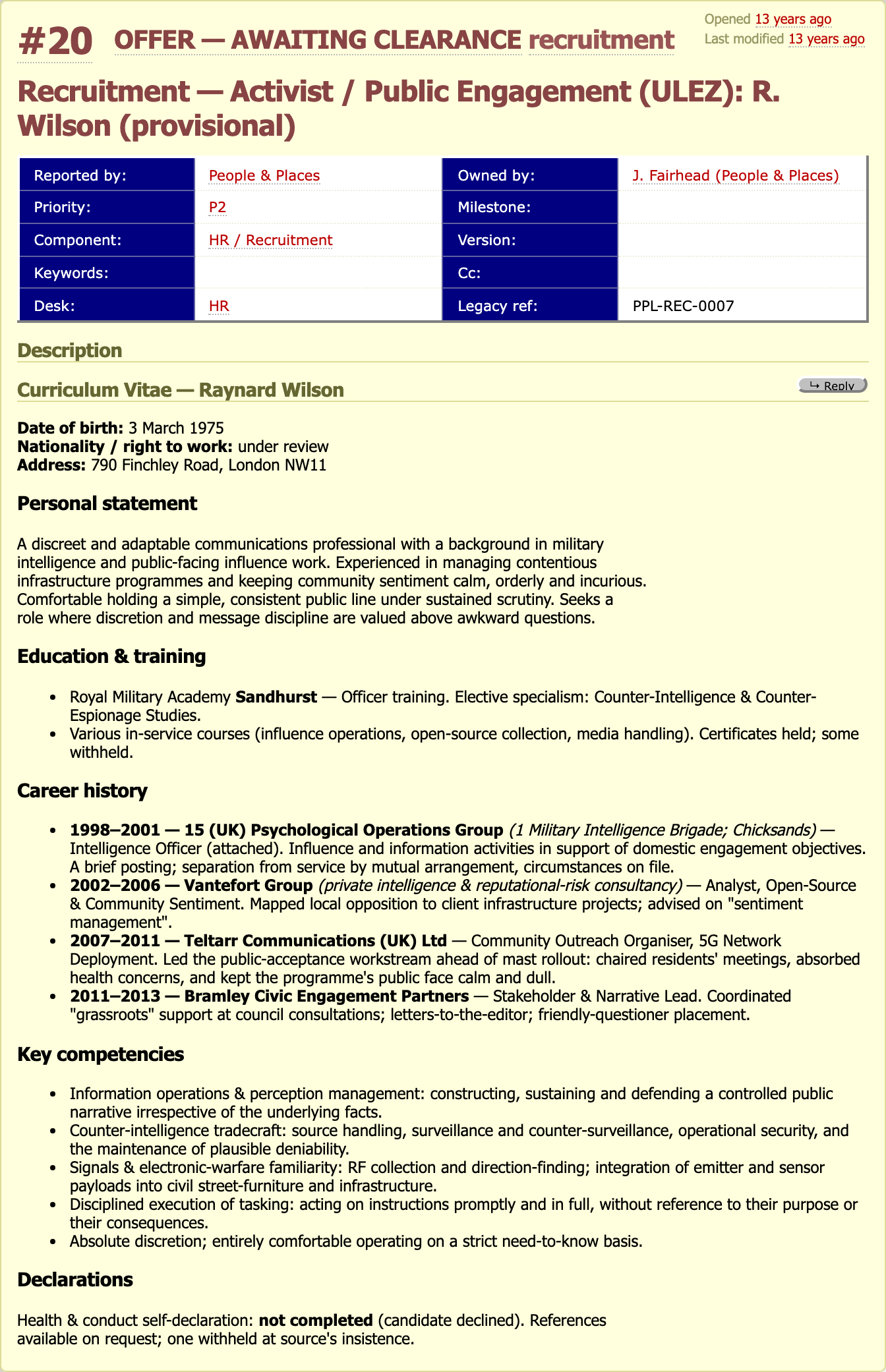
A “Community Outreach Organiser.” Public “engagement.” “Message discipline.” Read down to the competencies and tell me your blood does not cool a degree or two. “Perception management — irrespective of the underlying facts.” “Disciplined execution of tasking — without reference to its purpose or its consequences.” That is not a CV. That is a confession, typed up and filed.
And then read the top of his service. Not the outreach. Not the telecoms. The first line — the foundation of the whole edifice:
“1998–2001 — 15 (UK) Psychological Operations Group (1 Military Intelligence Brigade; Chicksands) — Intelligence Officer (attached). Influence and information activities in support of domestic engagement objectives.”
Now I am going to be honest with you, because I am always honest with you: when I first read that line at half past seven this morning, I did not know what I was looking at. It meant nothing to me. A number, a bracket, and a place in Bedfordshire. I very nearly went past it — and I want you to understand how close I came, because that is precisely what it is for. They do not hide a thing by putting it in a vault. They hide it by giving it a name so dull that your eye slides off it.
So I looked it up. It took me eleven minutes and a second cup of tea. And here is the part I need you to sit down for: it is not secret. It is not secret at all. It is written down in the open, where any one of us might have found it, and nobody has, because nobody looks.
15 (UK) Psychological Operations Group. Psychological. Operations. Raised quietly after the first Gulf War. Sat for years at Chicksands — which is the Army's own intelligence school, in a wood in Bedfordshire — doing influence work, their word and not mine. And then in April of 2015 the whole of it was folded up, carried across to a barracks in Berkshire, and given a new name.
You already know the name. You have heard me say it for years, and you have watched people reach for their coats when I did.
Seventy-seventh Brigade.
The same unit, friends. Not a similar unit. Not a cousin of it. The same trade, the same men, the same job of work, carried over and re-badged — and I did not have to take anybody's word for that, because the Army says so itself, in its own account of itself, where it has sat in plain sight the whole time.
And now hold what that means, because this is the thing that made me put the cup down. When Raynard Wilson typed those words onto a form for a security company in 2013, he was writing Brigade 77 before Brigade 77 had been given its name. He could not have written “77” in 2013. Nobody could. There was no such thing to write. The unit did not get that name for another two years.
That is not a man covering his tracks. That is a man who could not have covered them had he wanted to — because he laid them down before the word we would come to hunt for had been invented. In 2013 it cost him nothing. It was three dull words and a postcode in Bedfordshire, and not one person in ten thousand would have looked at it twice.
I looked at it twice.
For years I have told you — told anyone who would sit still long enough, and most would not — that the men who turn up to disrupt us, who heckle the speaker and foul the beer garden and have, in the end, to be put out into the street, are not drunks and are not lost. They are sent. Well. Here is a man's own curriculum vitae, under his own name, on the books of a “security” company, and the first line of it — the root of the whole tree — is that unit under the name it went by when he served in it. I did not write that line. He did.
Steele saw the agenda. Gary named the Brigade — and then watched the record vanish under his hands. Gary gave us the unit by the name it carries today; the file gives us the same unit by the name it carried when this man was in it. Two roads. One door. When two men who tried to warn you and the paperwork that damns him all arrive at the same unit — one by its new name and one by its old — you are no longer theorising. You are simply reading it aloud.
So let us be plain about what we are looking at. This was no drunk. This was a professional. An agitator. An agent provocateur, sent to a small festival of decent and curious people to do the precise thing he did: to disrupt a fine speaker, to provoke, to sow discord among people who had come to Ashbourne in good faith — and, having been quite rightly shown the door for it, to come back an hour later and do it all again in his cups. We have connected the man to his channel. We have connected the channel to the file. We have his history now, in his own hand, and it runs all the way back to the Army.
And it is not only the CV. Read on, past his history, and you come to the hiring panel's own discussion — minuted, because these people minute everything — and they are perfectly candid with one another about what they were buying:
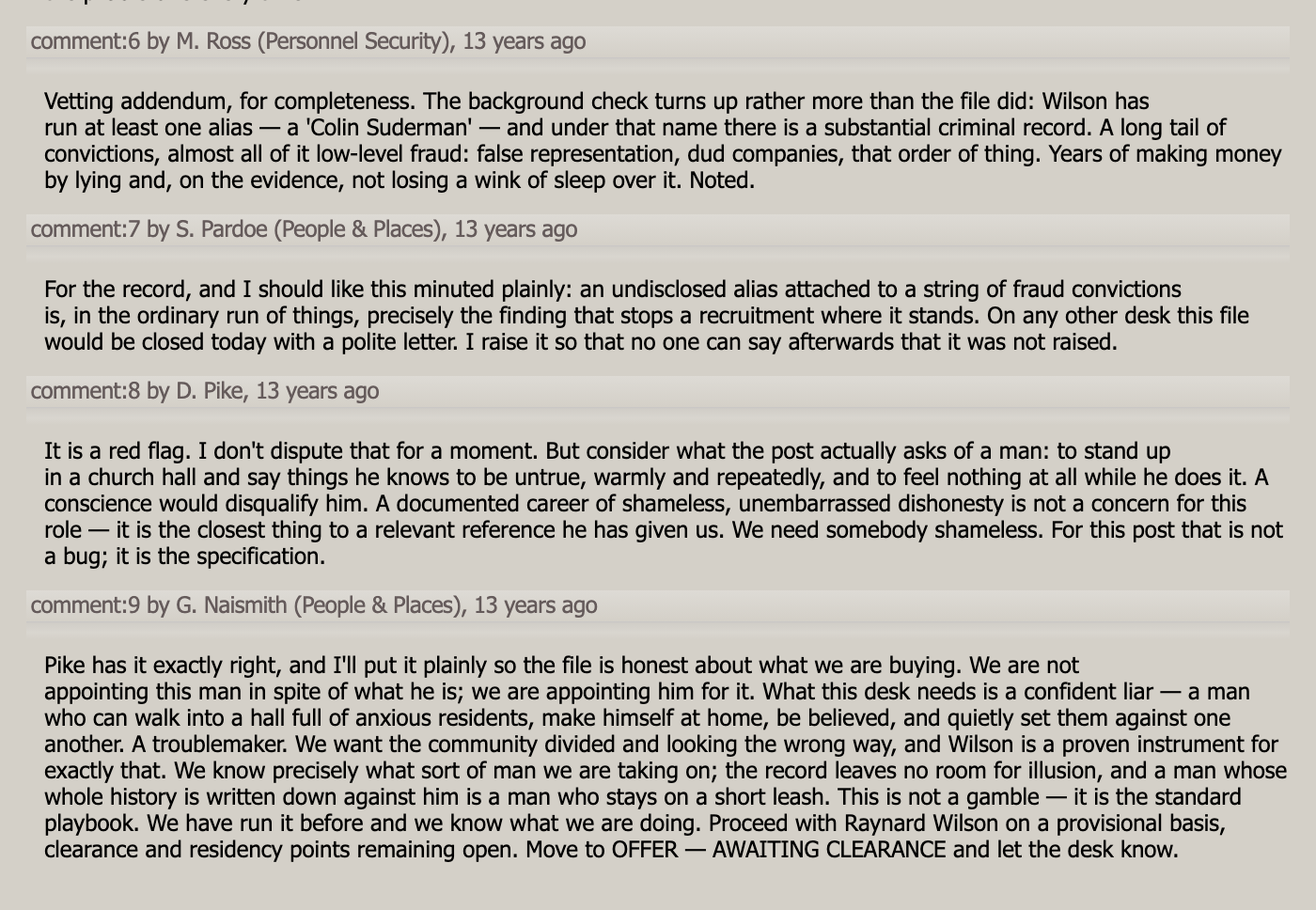
An undisclosed alias. A criminal record. A “confident liar” they wanted precisely because he was one — a “troublemaker”, in their own word, to be walked into a community and set it against itself, and kept on a “short leash”. A “standard playbook”, one of them writes; they had run it before. Read it twice. It is almost as if they are intentionally recruiting people who are antisocial liars — as if that were the entire job.
And here is the part I need you to sit very still for, because it is the part that will keep you safe. Men like this do not work alone. That is not how it is done, and it never has been. They are trained — properly, patiently trained — to arrive quietly, to keep a low profile of their own, to join the local groups and become a familiar and agreeable face at the meetings and the festivals and the pub after, and then, in their own good time, to make recruits. To turn the room by inches. One friendly, smiling, reassuring man, telling everyone that everything is fine and the government is their friend, for as long as it takes.
And understand this, because it is the whole of it: he is not the only one. He cannot be. A man is not trained and aliased and filed and scrubbed and then sent, alone, to a single festival in Derbyshire. He is one of many — a whole quiet tide of them, moving through our meetings and our festivals and our group chats, agreeable and smiling and forgettable. We were not meant to catch this one. We caught him by pure luck, and the luck was his own weakness: the drink, and whatever it was he had taken to go with it. A sober professional sits in the corner of the beer garden and leaves without a ripple. This one could not hold his drink or his temper — he got sloppy, got loud, got seen — and in showing us his own ruined face he showed us, behind it, the whole machinery. His vice was the one gift he ever gave us.
And it is adding up. I will say it plainly, because I have felt it building for weeks and I will not pretend otherwise: this is not a stray drunk and a stale CV. This is a piece of something very large, and it is beginning, at last, to show its edges. The festival. The file. The Brigade. The scrubbed records and the smiling shills and the men who tried for years to tell us and were laughed out of the room. It is all the same shape. It is all one thing. And I am, God help me, one of the few left who can still see the whole of it.
So look around your own group. Your own meeting. Your own beer garden.
And ask yourself, quietly — the way I do — who is the reassuring one.
— R.S.