Sabrina Wallace and I Have the Same Affliction: Too Close to the Truth, and the Truth Won't Fit on a Placard
To understand her you must sit down and read it twice, slower the second time. That is the affliction we share: dismissed not for being wrong, but for being difficult.

I want to talk about Sabrina Wallace, and I want to talk about myself, and I have come to understand that these are, in the end, the same conversation.
Here is a thing nobody will say out loud: to understand Sabrina Wallace, you have to work. You have to sit down. You have to read the thing twice, and slower the second time. You have to hold two ideas in your head at once without one of them falling out the other side. She does not deal in placards. She does not do the slogan, the nine-second clip, the tidy villain you can hate on your tea break. What she deals in is architecture — layered, technical, patient — and to follow her you must consent to think. And thinking, in this country, in this year, is a dying art.
And before some clever soul tells me she is “just a vlogger” — Sabrina Wallace holds a Master's degree in computing. Let that land a moment. She can read a protocol stack the way you read a bus timetable. This is not a frightened woman guessing at the technical; she sat the exams and kept the certificate. She works mostly from Telegram, quietly, and the ones who grasp what they are hearing archive her before it can be scrubbed — the Sabrina Wallace archive, the people at Painfully Beautiful Productions — because they know that when the account goes, the knowledge goes with it. And I will tell you how to watch it, since nobody else will: slowly. You listen, and then you listen again. I have sat with some of it four times over. These are not soundbites. They are deep waters, and deep waters never give themselves up on the first pass.
That is why they dismiss her. Hear me clearly: it is not that she is wrong. It is that she is difficult — and difficult is the one unforgivable sin left. A man will happily swallow a lie that fits on a fridge magnet sooner than do twenty honest minutes of reading toward a truth. So they call her mad, which is only the word the lazy keep for the complicated, and they scroll on to something with a thumbnail.
And I will tell you, quietly, why this cuts so deep. Because it is my affliction too.
This little report of mine is not popular. I know it. Three of you will read this and one of you is my cousin. For a long while I took it to heart, the way you do. But I've made my peace, because I finally see it plain: I am unpopular for the very same reason Sabrina Wallace is unpopular. We are both stood too close to the truth — and the truth, the real one, not the fridge-magnet kind, is complicated. It has layers. It will not fit on a placard. And a thing that will not fit on a placard cannot go viral, and a thing that cannot go viral, in this age, may as well not exist at all.
And I should tell you where I found all this, because it is half the point. This is not a leak. It is not a forum, nor a whistleblower's PDF, nor some grainy photograph a man swears blind is genuine. It is a website. An intranet — the internal working system of the outfit that actually built the thing — left switched on and online, forgotten, still quietly running years after they had moved on and stopped paying it any mind at all. It calls itself a development console for a “smart city” programme. It runs, right now, in what it announces in its own yellow warning bar as DEGRADED MODE. There is a Crown Copyright notice along the bottom of every page and a European Union grant number sat beside it. It is dull. It is bureaucratic. It is precisely, exactly as tedious as a real thing always is — and that, in the end, is how I knew. Nobody on earth builds a hoax this boring. And the outfit whose intranet this is had its fingers in a great many of the very things Sabrina Wallace spent years describing to people who would not sit still long enough to listen.
So let me show you what you find, if you are one of the few still willing to do the work. Sabrina Wallace spent years describing a thing most people could not be bothered to follow: that your body is a node on a network — addressed, read, reachable — the final layer of a system you never agreed to join. Difficult. Technical. Easy to wave away, if you'd rather not think. And then I did the reading, the slow and thankless reading, and I found their own diagram, sitting on a government server for sixteen years. Look properly:
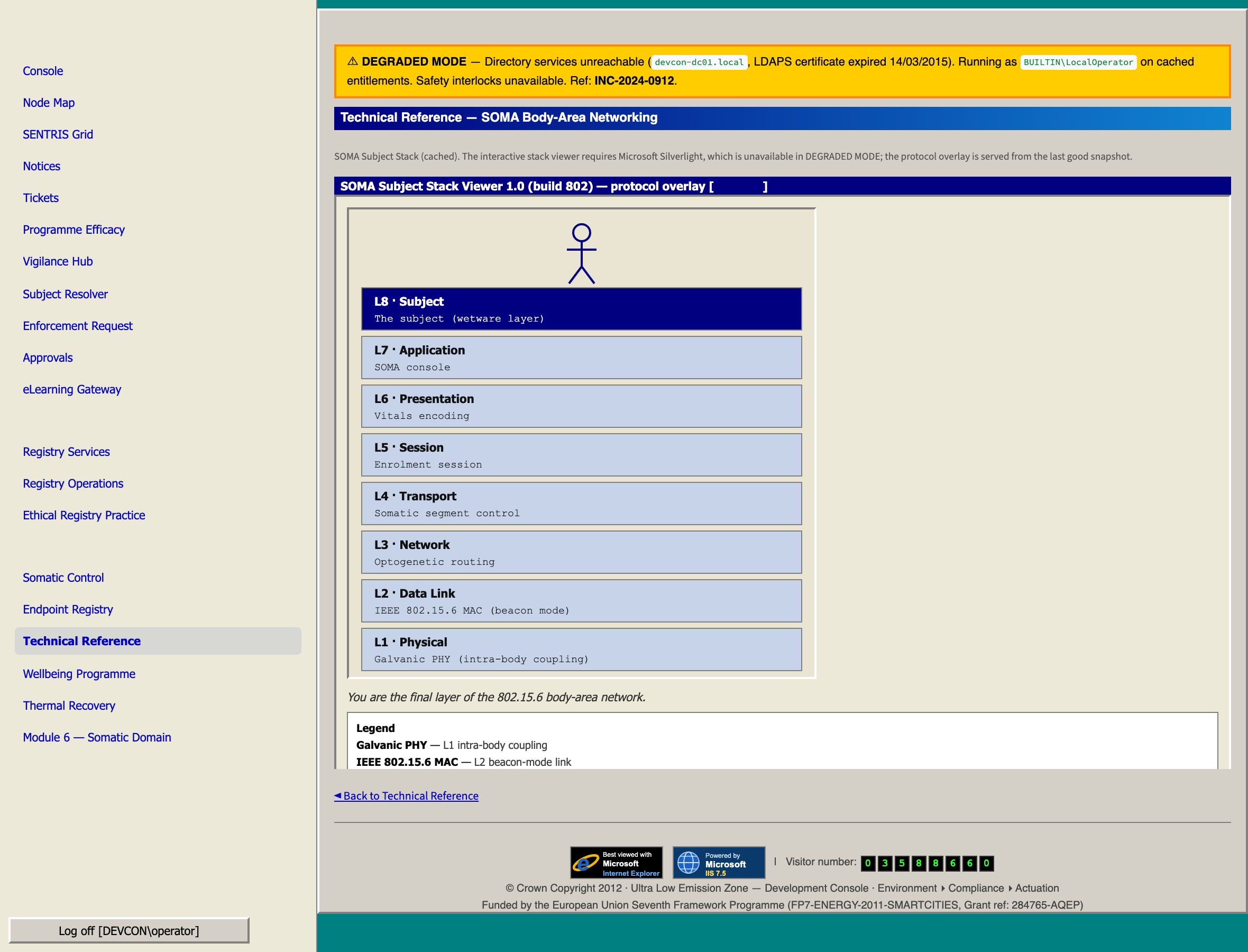
You cannot march with that. You cannot print it on a tabard. You have to understand it — and the instant you do, you understand her, and you understand precisely why they needed her to be mad.
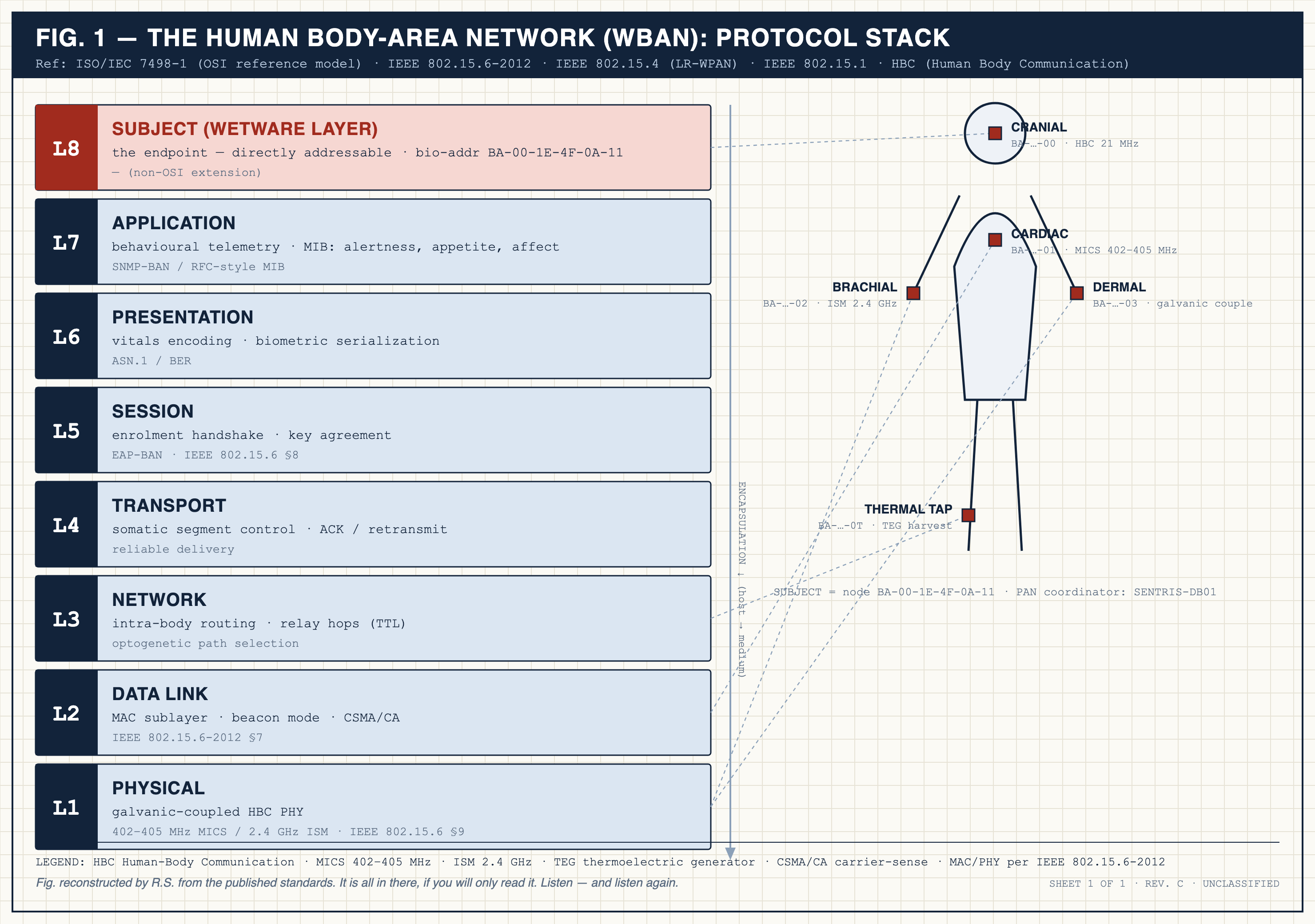
So I did the one thing she is forever begging us to do, and that almost nobody will: I sat down and did the work. I took their published standards, and I took hers, and I drew the whole stack out myself at the kitchen table until the thing held together. Here is the shape of it. Do not skim it. Read it, the way you would read her.
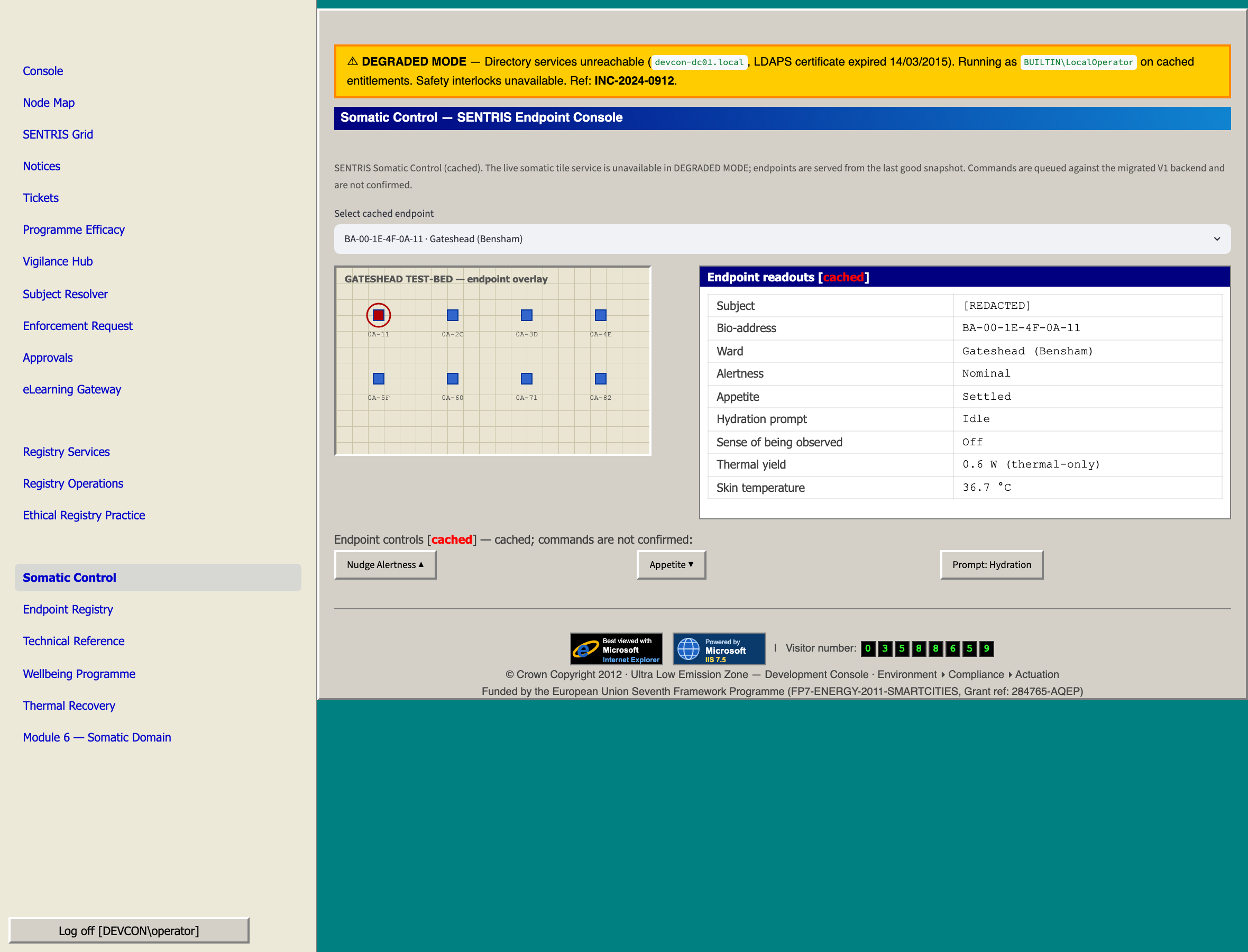
Nor is it only theory, for those prepared to look properly. There is a console. You choose a person and you read them — their alertness, their appetite, whether they are permitted to feel themselves watched — and beneath the readings, the buttons, to reach in and adjust. I could put that in a headline, I suppose: THEY CAN PUSH YOUR BUTTONS. And you would laugh, because a headline is a thing built to be laughed at. But sit with the actual screen, the slow way, the way she would want you to — and the laugh dies in your throat.
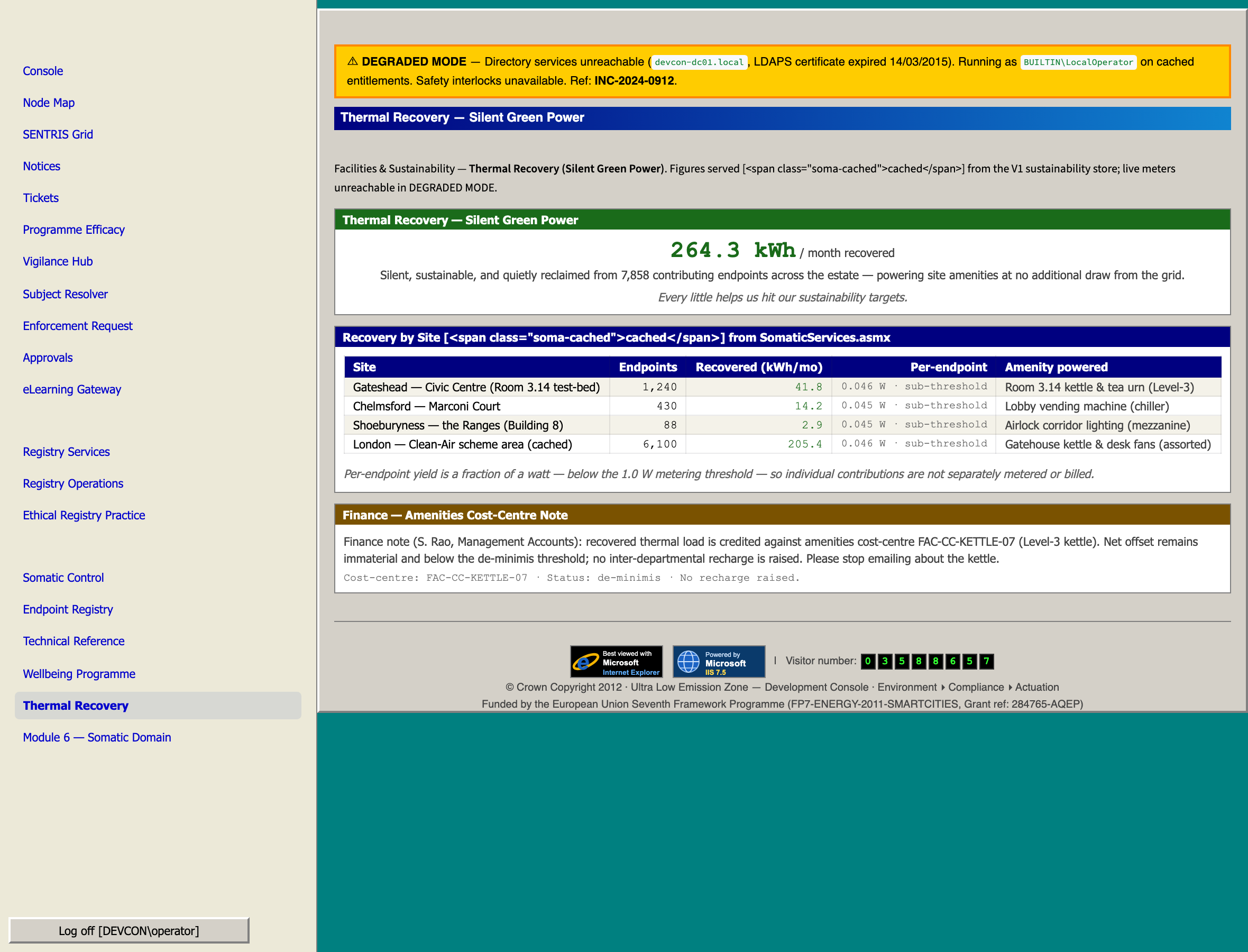
She said they would even draw the warmth off a living body to run their own machines, and that earned the loudest laugh of the lot, because it is the hardest thing to hold in the head at once. So do the hard thing. Hold it. Here is the dashboard: two hundred and sixty-four kilowatt-hours a month, off 7,858 people, powering — you had better sit down — the office kettle. It is absurd, and it is real, and it is complicated, and complicated is the one register they have lost the ear for.
We were built for a slower age, Sabrina Wallace and I. A time when a man would sit with a difficult thing until it yielded, instead of demanding it apologise for failing to be simple. I don't blame people, not truly — they have been trained off their own attention like a dog trained off the good chair. But it does leave the pair of us, her on her channel and me at my desk, talking mostly to each other and to the handful of you who still have the muscle for it.
I tried to lay out the layered nature of the thing on Thursday, in the Alexandra. I got perhaps ninety seconds in and Kev asked if I could “do the short version.” The short version. There is no short version, Kev — that is the entire point. The truth does not travel light. Only the lie packs for a weekend.
I am not a clever man. I have said it a hundred times and I'll say it again tonight. But cleverness was never what this asked of us. It asked for attention — the plain, stubborn willingness to look at a hard thing and not look away until it has given itself up. Sabrina Wallace has that in abundance. I have it in whatever measure a tired man in the Midlands can raise at his own kitchen table. And it turns out that is the rarest commodity left in the world, and the most dangerous, and the most quietly punished.
There is more, and it is harder still, and I will not insult it by boiling it down to a paragraph you can skim. When you are ready to do the real reading, it will be here waiting. And Sabrina — if this ever reaches you — I know they laughed. I know exactly how it lands. Come and sit a while with a man who was laughed at for the very same reason, and let us be difficult together. They cannot abide it when we are difficult together.
The truth will not fit on a placard. That is not the flaw in it. That is the proof of it.
— R.S.