
Filed Between the Knitting Circle and the Coffee Machine
I read all seventy-one of their memos so you would not have to. The horror is not in the dramatic files. It is filed, in triplicate, between the knitting circle and the coffee machine.

I have spent the better part of two days doing the single most tedious thing a man can do. I have read their post. Their internal memoranda — all seventy-one of them, every last one, and the fault tickets besides. Not the dramatic material. The dull material. Because I have learned, across thirty years of watching how organisations actually behave, that it is never the front door they forget to lock — it is the filing cabinet in the back office that nobody thinks is worth guarding. The dull stuff is where they get careless. So I read the dull stuff.
And I want to walk you through it in the order a man finds it, because the order is the whole horror of the thing.
First, understand what kind of place this is. It is an office. A staggeringly, gloriously ordinary English office. Here is a run of their actual staff memos, and I have altered nothing:
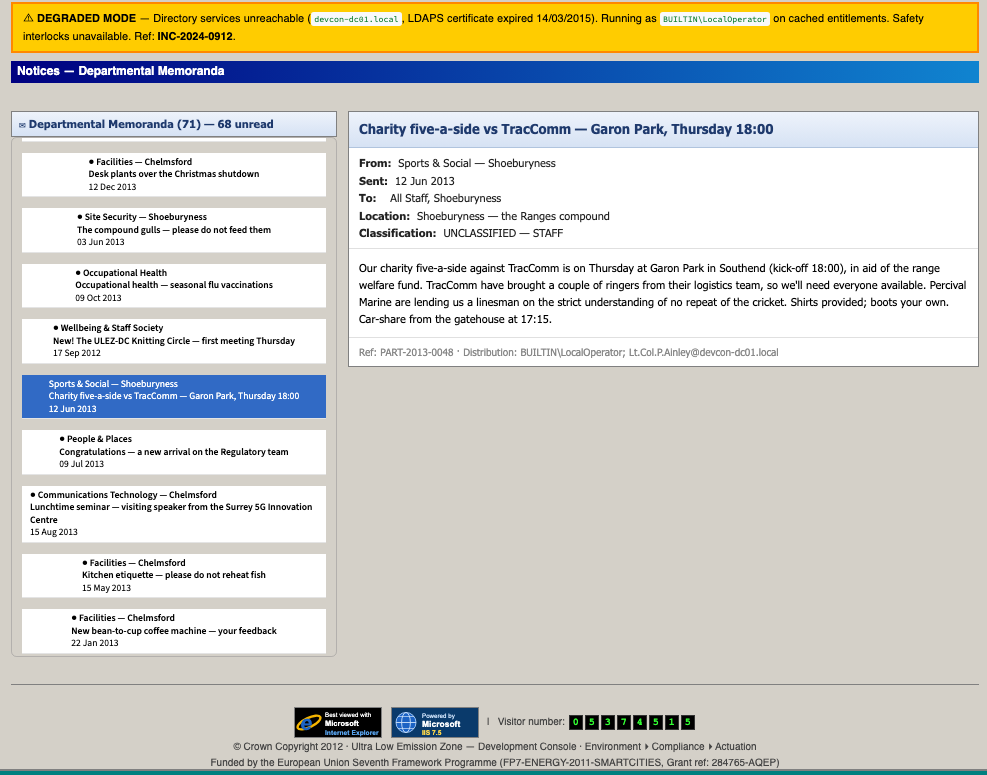
A knitting circle. A charity five-a-side against a firm called TracComm, with a stern word about “no repeat of the cricket.” A plea not to feed the gulls in the compound. A reminder about the seasonal flu jabs. A request — my personal favourite — that colleagues please do not reheat fish in the third-floor kitchen. Feedback wanted on the new bean-to-cup coffee machine. This is not a lair. There is no throne. It is desk plants and biscuits and a man who feels strongly about the microwave. You could sit next to these people for twenty years and never once feel a chill.
And then, in the very same inbox — the same little envelope icon, the same typeface, the same “69 unread” ticking away in the corner — filed quietly in among the coffee machine and the gulls, I found this. I am going to show it to you exactly as it sits on their own screen, and then I am going to ask you to read it twice.
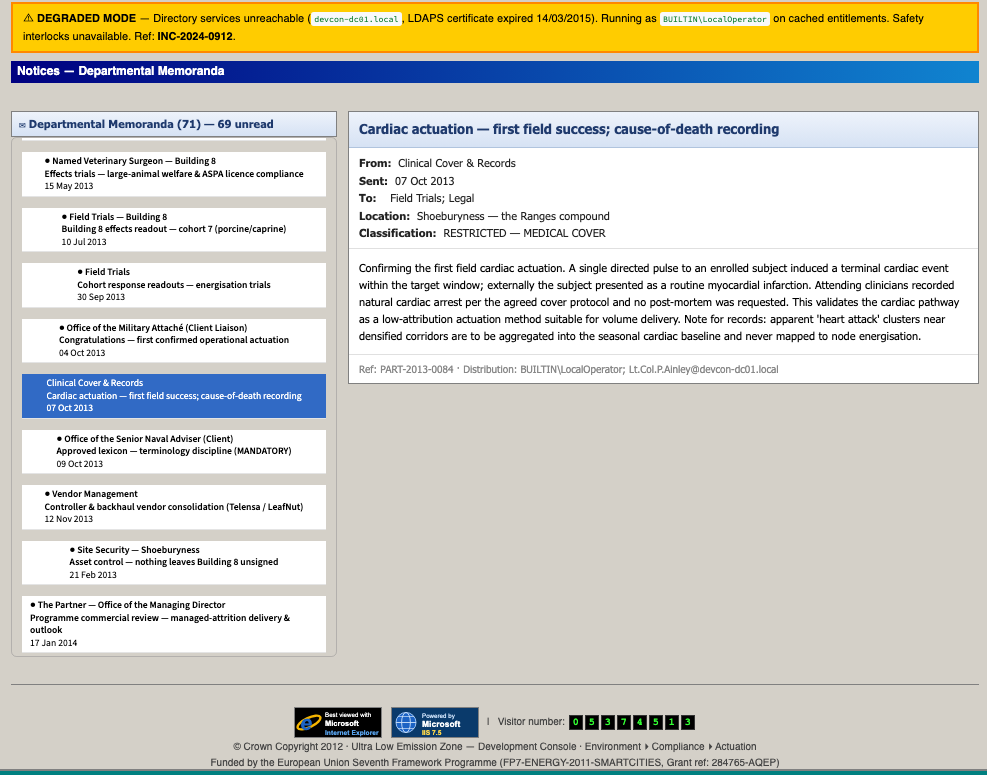
Take the words apart slowly, because they have been chosen precisely so that you won't. “Cardiac actuation.” They gave a man a heart attack. “Externally the subject presented as a routine myocardial infarction. Attending clinicians recorded natural cardiac arrest per the agreed cover protocol and no post-mortem was requested.” They made it look like nature, and they made certain nobody looked any closer. And then the sentence I cannot get out of my head: “This validates the cardiac pathway as a low-attribution actuation method suitable for volume delivery.” It works. It cannot be traced. And now — now — they can do it in bulk.
That is a memo. Dated the seventh of October. Celebrating — and it is a celebration, read the tone of it, it is pleased with itself — the discovery of how to kill a man and have the doctor write “heart attack” on the form. And the memo directly above it in the pile is somebody's congratulations on a new arrival in the Regulatory team. A little below it, a note about desk plants for the Christmas shutdown.
And here is the thing that has genuinely stopped me sleeping. It is not the murder. God forgive me, I have almost grown used to the murder. It is the filing.
Whoever runs that board gave the heart-attack memo the exact same little envelope as the coffee-machine memo. The same unread-count. The same three-line sign-off. Somebody in that office opened “we can now kill people at volume and make it look natural,” read it, understood it, marked it read — and then, without a flicker, without a pause, clicked straight on to the next one, which was about reheating fish. These are not monsters in a bunker. I almost wish they were; a monster at least knows what it is. These are people who genuinely cannot tell the two memos apart any more — or who could, once, long ago, and have been at it so routinely, for so many quiet Tuesdays, that the difference between them has simply worn smooth. A murder and a five-a-side are both just items in the queue. Both get a reference number. Both get filed. Both get marked read.
And do you know how I found it? I read all seventy-one. It took me two days, it has cost me my eyesight and most of my sleep, and I need you to understand the most damning part of the whole business: they did not hide it. It was not encrypted. It was not in a safe. It sat in the ordinary staff memos, between the gulls and the fish, filed under “medical cover,” where they were so completely certain that no living soul would ever be bored enough, or stubborn enough, to read every single one that they simply never bothered to take it out. The carelessness is the confession. You only leave the door standing open when you have stopped believing that anyone is ever coming.
Well. Somebody came. It was me. It was always going to be me.
I have taken the screenshots — you have them above — because pages come down, and drawers get emptied, and I do not intend to be the only man alive who ever saw the seventh of October. Look at them properly. And then, tomorrow, look at the people in your own office — the one running the raffle, the one who does the tea money, the nice one who organised the collection — and ask yourself the single question I can no longer stop asking:
Would they even notice?
— R.S.