
He Has a Website. It Was on Google the Whole Time. And He Is Bragging.
I did it the hard way — the filings, the fraud, the alias. And then I typed his name into Google. First result: a website where Raynard Wilson advertises, for a fee, the destruction of people like us. He is not hiding. He is proud.


I owe you a confession, and it is not a comfortable one. You have watched me, these past weeks, do this the hard way. The Companies House filings. The dead firms and the two fraud judgments. The alias — Colin Sudamen — the same date of birth, the same door on Finchley Road, one name handed to the other like a coat. Weeks of it. Cold tea and a hot laptop and the small grey hours. And then, last night, for reasons I still cannot fully explain to myself, I did the one thing I had never once thought to do in all that time. I typed his name into Google.
It was the first result. Not the second. The first.

How? How has nobody seen this? I have turned that question over all night and I think, at last, I understand. We look for the truth in the dark corners — the leaked server, the scrubbed record, the file that was never meant to be read. It does not occur to us to look at the thing standing in the shop window with the lights on. “Hidden in plain sight” is not a figure of speech. It is a method. The most dangerous document in England is the one boring enough that nobody bothers to read it.
Because you read it, and it stops being boring very quickly indeed.

“Perception management — shaping a settled public understanding of what a client does, irrespective of the underlying facts.” Read that last phrase again, slowly. Irrespective of the underlying facts. He has written down, on his own public website, that the truth is simply not his concern. And then — I had to put the mug down for this one — the flagship. A channel, a podcast, a thing he calls “Owned Media,” whose purpose he sets out in black and white as “reputation management and social control.” Social control. He typed those two words next to each other and he was proud of them.
And there is more, because of course there is more. He has a product — he has given it a name, BELLWETHER, the way a man names the thing he is proudest of — and it is a service that tracks, and I am quoting him exactly, “the community groups, campaigns and conspiracy-theory movements that pose a risk” to his clients. That is us. That is you and me and everyone reading this. He has built a machine to watch us, he sells the watching to corporations by the month, and he advertises it with the calm little smile of a man selling a conservatory.
And then I found the case study, and I have not slept since.
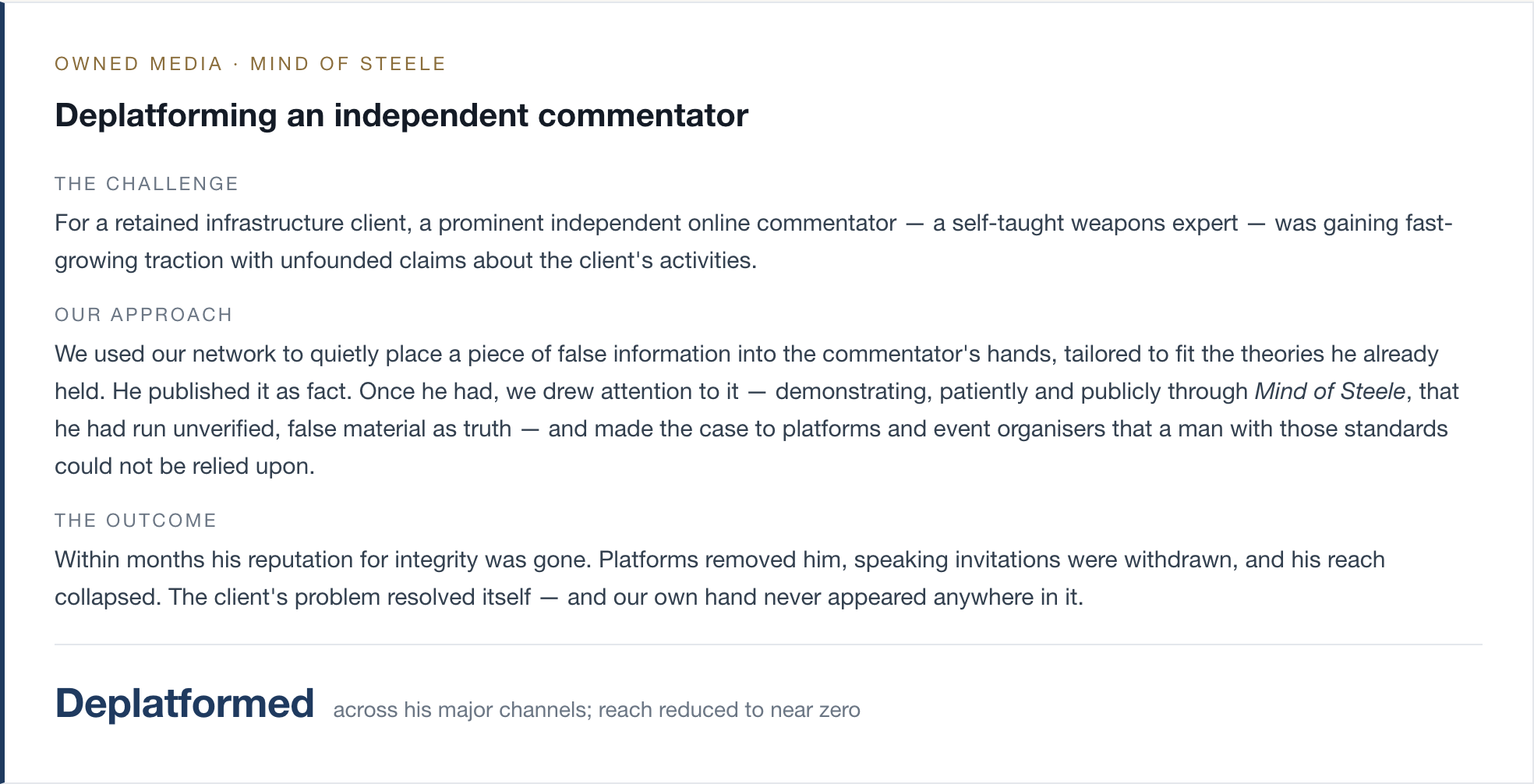
“Deplatforming an independent commentator.” A self-taught weapons expert, he says, was “gaining traction with unfounded claims.” So — his words, not mine — they “used our network to quietly place a piece of false information into the commentator's hands, tailored to fit the theories he already held. He published it as fact.” And then, having handed the man a lie and waited for him to repeat it, they set about destroying his reputation for integrity and pressed every platform and every event that would have him to drop him.
I know who that is. You know who that is. There is only one self-taught weapons expert this movement has ever had, only one man who has warned us for years — and correctly — about what the streetlights and the masts truly are, and who has been hounded and de-platformed and dragged through the courts for the trouble of it. They fed him a lie. They waited. And then they turned his own honesty into the knife — because an honest man repeats what he is told by someone he has been made to trust — and they put it on their website as an advertisement. “Rates on application.”
Let me be careful, and let me be fair, and let me be exact about the man. Raynard Wilson is not a fanatic. He does not believe in anything at all. A fanatic I could almost respect; a fanatic is at least in the grip of something larger than himself. This is worse, and it is smaller. This is a man who destroys people — their names, their livelihoods, their standing among the only friends they have — for money. For a fee. Rates on application. He would do it to you and he would do it to me and he would not lose one minute's sleep over either of us, because to him it is not cruelty, it is a Tuesday, it is the invoice at the end of the month. There is no cause here. There is no belief. There is only the quick buck, and a man who thinks absolutely nothing of ruining a life to earn one.
And yes. Yes. I can hear you. Roy, it was on Google. You spent three weeks in the Companies House records and the answer was on the front page of Google the entire time. I have sat with that, believe me, in the dark, at some length. But I will tell you why I do not regret a single hour of the hard way. If I had only found the website, you would not have believed me — you would have said, it is a consultancy, Roy, they all talk like that. It is the paper trail behind the website that makes the website damning: the aliases, the dead firms, the courts that already used the word “dishonest.” I did it the slow way so that when I finally held up the easy thing, it would be unanswerable. I am not a clever man. I have told you that before and I will tell you again. But I am a thorough one, and thoroughness, in the end, is the rarer gift and worth a great deal more.
Go and look. I mean it. I will not link it and I will not send him the traffic, but you have fingers and you have a keyboard, and the name is not hard to spell. Read it with your own eyes, and then come back and tell me I have imagined all of this. He is not afraid of you seeing it — that is the part I cannot get past, the part that keeps me at the window at four in the morning. He is not afraid. A man only advertises the thing he does when he is quite certain that nobody who matters will ever, ever do anything about it. Ask yourself who has to be standing behind a man for him to be that unafraid.
I am going to make a cup of tea. I have earned it. And I am going to sit with the plain fact of it: that the most frightening thing I have ever found, I found not in a locked drawer but in a lit shop window, at the very top of a search, where it has been sitting, patiently, in plain sight, all this time — waiting for somebody thorough enough, and stupid enough, to type in the name.
— R.S.