
They Told Me These Men Have Never Existed. Then He Began Reading Names.

I want to say at the outset that I am not a man who is frightened of a telephone.
Thirty years on a helpdesk. Thirty years of being shouted at by people who had deleted their own file and wanted it to be my fault. I have talked a purchasing director down off a ceiling at four in the afternoon on a Friday. I have sat on hold to three separate hardware vendors simultaneously, on three separate handsets, and got all three to blink. Whatever else I am not, I am a man who knows how to be a nuisance to an organisation politely and at length.
So when I say that I was perfectly prepared for a simple call to Companies House, understand that I mean it. This was, of all the things I have attempted in these three weeks, the one I was actually qualified for.
It went very badly indeed, and I have not slept, and I am going to set it down exactly as it happened while I still have the order of it straight.
First, what I had in front of me
A correspondent sent me this. I have checked it against my own memory of the register and I have no reason to doubt it.
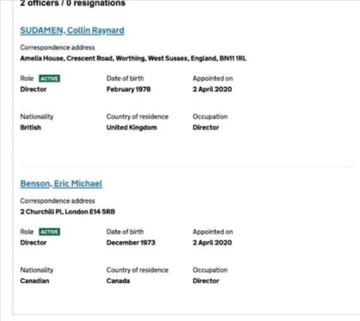
CYM LIMITED. Company number 14944784. Two officers, nought resignations.
SUDAMEN, Collin Raynard. Director. Active. Born February 1978. British. Correspondence address in Worthing, West Sussex.
Benson, Eric Michael. Director. Active. Born December 1973. Canadian. Resident in Canada. An address at Churchill Place, which those of you who have ever had cause to visit the Isle of Dogs will recognise as one of the towers.
And both of them — both of them, the same line, the same day — appointed on 2 April 2020.
Now. Regular readers will already be sitting up. Because I have shown you, from his own second CV, that Sudamen was employed full-time and on-site by the British Army until July of 2020.
Which means he took a directorship of this company three months before he left. While still in uniform. While still, on his own account, a disinformation officer at a barracks in Berkshire.
That is not a man scratching about for something to do. That is a man being moved — signed onto the next thing while still drawing pay from the last one, which is not how a career works but is exactly how a posting works. They did not let him go. They put him somewhere.
And Worthing, friends. West Sussex. Hold that too, because the other profile — the one about nano-lipids and the extraction facility — gives its location as Sussex, and I do not believe in coincidences and I have not believed in them for some years now.
So I telephoned them
Tuesday, twenty past nine in the morning, from the kitchen with a fresh mug and the number written on the back of the envelope with everything else.
It began perfectly normally. I read out the company number. I read out the two names, spelling both, because I am careful and because one of them has a spelling that people get wrong. I asked a simple question: were these two men ever recorded as officers of this company, and if the record has changed, when did it change and who asked for it to change.
The lady I spoke to was, I want to say, entirely pleasant. Softly spoken. She had an accent that took me somewhere I had not been in thirty years — a girl I knew in Berkhamsted in the eighties, and I will say no more about that except that for about ninety seconds I was rather enjoying the call.
Then she told me I had the wrong number.
I said I did not. I read it back. She agreed I had read it correctly, and told me the number was for a different company entirely, and that no persons of those names had ever been officers of it.
I said I had a screenshot in front of me.
And she said — and she was kind about it, that is what I cannot get past, she was kind — that she was very sorry but there was no record of those individuals. Not "not at this company." No record. As though I had rung up to ask about two men I had dreamed. As though the videos, the profiles, the interviews, the whole visible public existence of two men that any one of you can watch this evening, were a thing I had assembled in my own head.
I have been told I am mistaken many times in my life. I have never before been told, by an arm of the state, that a person I have watched with my own eyes has never existed.
The music
I asked for her manager.
Things changed after that, and I want to be fair and say they changed as swiftly as anything ever changes in a government call centre — which is to say I was placed on hold for fifteen minutes.
You know the music. Everybody knows the music. That Cisco hold loop, the one every council and every utility and every hospital appointments line in this country has been running since before some of you were born. This one.
Fifteen minutes of it. And I sat there with my tea going down and down, and I thought — and I want you to know I thought this before anything else happened, because it is going to sound like hindsight and it is not —
Did they commission this to torture us?
Because it is not soothing. It has never once soothed anybody. It is four bars that never resolve, and it is designed, I am now certain, to make a man forget the question he rang up to ask.
By the time it stopped I had finished the tea. Which turned out to be a mercy, because I would have dropped the mug.
"Ah, Mr Sabin. How may we help you today?"
That is what he said. Those words.
He knew my name.
I had not given it to the first lady. I had given a company number and two spellings and a question. I had not given my name, and I had not given my number, and I had certainly not given it to a man I had not yet spoken to.
And the voice. I want to describe the voice properly because the voice is the whole thing. Crisp. Public school, and not the modern sort — the old sort, the vowels that have never once had to hurry. And slow. The particular slowness of a man who has never in his working life had to finish a sentence before somebody more important interrupted him. A man used to giving instructions and waiting, comfortably, while they are carried out.
The damage was done by then, so I said my piece. I asked him plainly: what do these two men — the fellow behind Mind of Steele and his associate, Collin Sudamen and Eric Benson, whichever names they are using this month — have to do with a company that your own colleague has just told me does not exist?
He did not pause at all.
"It's simple," he said. "These people don't exist, the company is a fiction, and your little investigation will lead you precisely nowhere."
Your little investigation.
Not "I'm afraid I can't help." Not "you'd need to write in." He knew what I was doing. He knew what to call it. And he had a view about where it would lead.
According to this man, the company has never existed, has never existed, and the two individuals a great many of us have watched work patiently against this movement for years are entertainers. Innocents. Nothing whatever to do with a figment.
And then, pleased with himself — I could hear it, you can always hear it — he said, "I'll trust you to have a nice week," in the tone of a man closing a door.
And then I remembered the last thing
"What about the Maison?"
A beat. Then, quizzically, almost amused: "The maison?"

"Maison Éternelle," I said. "A wholly owned subsidiary of CYM Caring Corporation. It says so at the bottom of every page of their own website, in grey, where nobody reads. Acquired in 2020 — the same year your two non-existent men took their directorships."
And then I asked him the only question that has ever mattered in any of this:
How does a company that has never existed acquire another company?
Because here is the one thing thirty years of carrying a toolkit into other people's boardrooms taught me. I have been in those rooms. Not at the table — under it, mostly, on my knees with the projector lead, or at the back fixing the sound so that men in very good suits could be heard properly by other men in very good suits. Rooms adjacent to the server halls I looked after. I have heard more of that world than anybody ever intended me to hear.
And what I learned is this. Money can be a promissory note, and a note can be a favour, and a favour can be a line in a ledger nobody reads. Fine. But it has to come from somewhere. A funded acquisition of a Swiss house is not a rumour and it is not a vibe. It is a transfer, from an account, belonging to an entity, signed for by a human being with a name.
If CYM bought the Maison, CYM exists.
And if CYM does not exist, then somebody at the other end of my telephone was lying to me.
The laughter
Silence.
Long enough that I thought the line had gone. I said "hello?" twice, the way you do.
And then I heard something considerably worse than silence.
He was laughing.
Not a chuckle. Not the laugh of a man who has heard something funny. It went on, and it climbed, and there was nothing in it that had any warmth — the sound of something enjoying itself at a distance from anything human, and I am not a fanciful man and I am not going to dress it up any further than that.
And for one bad second it sounded like him. That sneering delivery. That laugh off the videos.
Then I remembered that the real Wilson is, on the best evidence available to me, presently sleeping something off in a ditch between two counties. And it came to me all at once, in the way things do when your mind has not got its armour on.
That was not him. That was one of them.
There are thousands of these people. Not clones — I want to be precise, I am not saying anything silly — but they may as well be. The same twelve schools. The same two universities. The same clubs, the same weeks in the same resorts, the same daughters at the same gymkhanas on the same Sunday mornings. One production line, running for two hundred years, and the product is a man who can say "these people don't exist" in a warm voice and mean it as a threat.
Which is when I finally understood the thing I had got wrong all along.
Wilson and Benson were never the story. They are nothing. They are cannon fodder. Two used-up instruments, one drinking himself sideways through Derbyshire and one filed under a Canadian address in a tower on the Isle of Dogs — and the men who used them do not think of them any more than you think of a biro that has stopped working.
That is the actual horror, and it took me until Tuesday morning to see it. It is not that they have contempt for us. It is that they have exactly the same contempt for their own. To a man like that, everyone below the line is disposable. Everyone. Including the ones who thought they were on the inside.
And then he began reading names
The laughter stopped as suddenly as it started.
And in the same pleasant, unhurried, faintly bored voice — the voice you would use to read a shopping list to somebody who had asked you to — he began to read.
My daughter's name.
My granddaughter's name.
The name of her primary school. The name of her class teacher. And then — and this is the detail that has kept me upright at the kitchen table since, because it is the detail that no database gives you, the detail that somebody has to have watched to know — the name of the little girl she sits next to.
He read them the way our first lady had read out a company number. Flatly. Correctly. In order.
And when he had finished he said, "All present and correct, you see. Everybody is on a register somewhere, Mr Sabin. That is rather the point of us."
And he waited.
He wanted me to ask. I understood that even then, with the room going small and grey at the edges — he was waiting for the question, so that he could enjoy declining to answer it.
And when I would not give him it, he gave me something else instead. Brightly. Helpfully. In the tone of a man reminding you to take a coat.
"Do be careful if you're planning to cross any roads today, Mr Sabin. The word is that we have eyes on every crossing."
Every crossing.
I want you to stop and think about what sits on a crossing. Think about what has been bolted to the top of every pelican and every puffin in this country these last few years. Think about who paid for it, and what the paperwork calls it, and what I have shown you it can do — and then think about a man in an office telling a fifty-one-year-old who has just had his granddaughter's timetable read to him that the word is they have eyes on every crossing.
That is not surveillance. Surveillance is a thing you say plainly, to frighten somebody into behaving. That was a man telling me where the equipment is, and letting me do the rest of the sentence myself.
And then it began again.
The laughing. On and on, and he did not stop it and I do not believe he could have — the sound of a man for whom the suffering of the world and a death sentence delivered down a telephone line are the same thing, and the thing they are is the funniest joke ever told.
I hung up on a government department, which I have never done in my life, and I sat in my own kitchen with the cold sweat coming down my back and my hands going, and I could smell my own fear in the room with me. That is not a figure of speech. It has a smell. I did not know that. I know it now.
What I understood afterwards
I sat there a long while, and when I could think again the thing I thought was not about me at all.
It was: so this is what it is like.
This is what it has been like for Mark Steele, all these years, while people who have never once checked anything laughed at him in comment sections. This is what Gary Waterman has been carrying, patiently, going back to look a second time and finding the record gone. This is Matt Houston, told he is wrong by everybody with a platform and standing there anyway. This is every single person who has ever been sneered at for standing up and saying that the world might not be quite the shape we were all told it was.
I always admired them. I did not, until Tuesday morning, understand them. There is a difference, and the difference is a telephone call.
They knew this feeling and they carried on. Every one of them knew exactly this feeling — the sweat, the small grey room, the voice that knows your family — and not one of them stopped.
I have spent my whole life believing, underneath everything, that we live in a fundamentally gentle world. That things are broadly fair, that institutions are broadly dull, that the worst you meet is indifference. I have written a great deal about being cheated and I do not think I ever truly believed anybody was malicious. Only careless.
On Tuesday morning a faceless man with a public-school voice took that away from me, deliberately, for sport, and threw down a gauntlet.
I have picked it up.
I am a man of no importance in a town nobody visits, and I have no salary, no cover and no protection. But I have thirty years of reading other people's systems, I have kept every receipt I ever had, and I have now got something they did not intend to give me: I know they are watching, which means I know they are worried.
You do not read a man his granddaughter's timetable because he is wrong.
Tomorrow I am going to take you inside the shop itself — the house that CYM bought with money from a company that has never existed. I have the pages. I have the prices. I have the part where they tell you, in writing, that you are not permitted to purchase.
And after that there is one more thing, which I have had for eight days now and have not been able to bring myself to write up, because it concerns what the Maison actually sells and where it comes from — and I want every document in my hand before I put that in front of you, because when I do, none of us will be able to un-know it.
Piece by piece. I will take you through all of it.
— R.S.