The Birds Went Quiet on My Street. I Have Been Counting.
I counted the birds outside my flat from nine down to none, and I am the only man on the street with a notebook and the nerve to write the numbers down.

I want to tell you about a sound you have stopped hearing, and I want to tell you that it did not stop by accident.
There is a thing that used to happen outside my window, every morning, whether I wanted it or not. A racket. A great ragged chorus of it, sparrows and starlings and whatever else, all of them going at once before the light was properly up, so loud that in the old days I would pull the pillow over my head and curse them. I do not curse them any more. Because they are not there any more. And a man who has spent his life being told he imagines things has learned to do one thing very well before he opens his mouth, and that thing is: count.
So I counted.
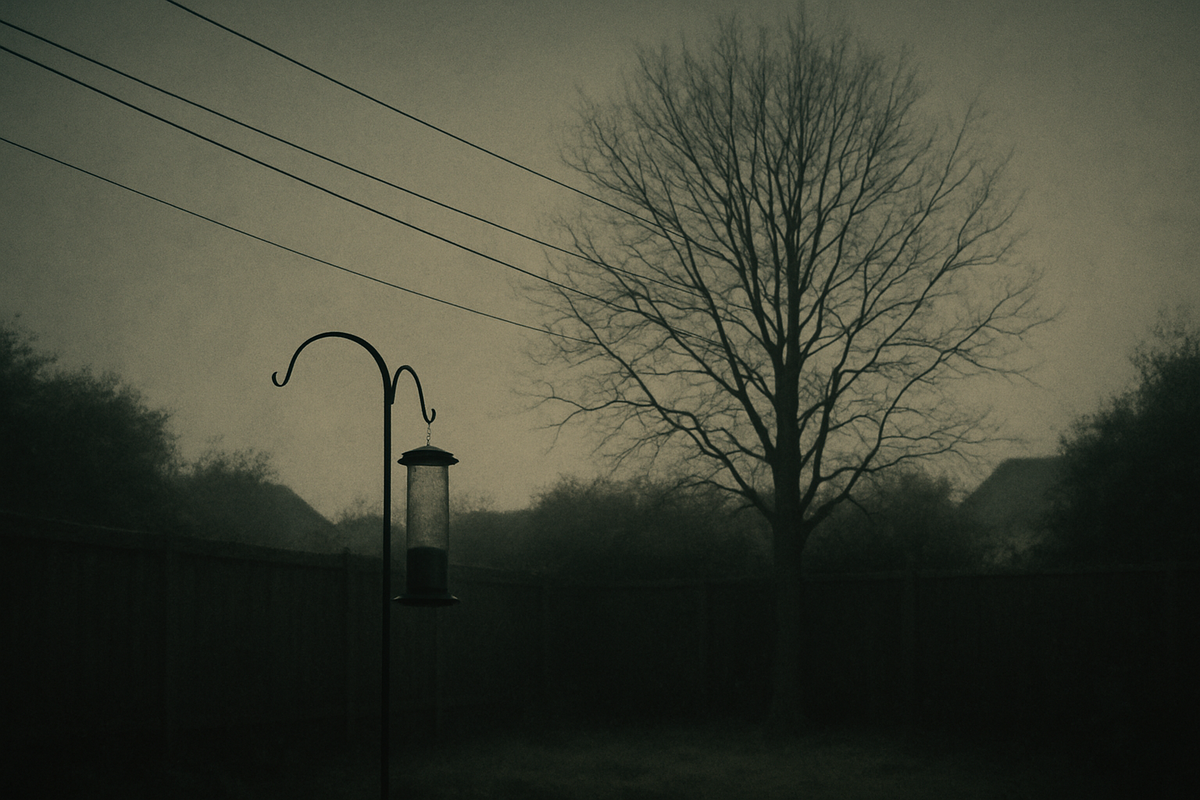
I got a notebook — a real one, a Silvine, from the shop, not a phone, because I do not trust the phone to keep the tally honest — and I have been keeping a record. Every morning since the back end of November I have been up before six, out at the little strip of garden behind the flats in Winshill, and I have been writing down the birds. Not guessing. Counting. On the fourteenth of November there were, by my hand, nine. Nine birds I could see or hear from the fence. By December it was four. Last Tuesday it was one, a single wood pigeon on the wire that did not so much as look at me, and yesterday, God help us, it was none. Zero. I stood on the stepladder with the notebook open and I wrote the figure down and my hand was not entirely steady when I did it.
Nine, to none, in the length of one notebook. You tell me that is weather.
And it is not only the birds, and this is where I need you to stop scrolling and sit very still, because this is the part that took the top of my head off. It is the insects as well. I drive a fair bit — I do a lot of miles, up and down, for reasons I will not go into — and there is a man I have started listening to, Matt Houston, a sound fellow, ULEZ and all the rest of it, and he said the thing I had been feeling in my chest for a year without the words for it. He said “there's no insects on my car, but before it used to be covered.” Covered. And I heard that and I went straight out to the car park with a torch and I looked at my own windscreen and, reader, it was clean. Clean as the day I bought it. No moths, no midges, nothing. In the summer of my childhood you could not see out of a windscreen by August. Now you could perform surgery on it. Where did they go? Nobody will tell you where they went.
Mark Steele will tell you where they went. Mark has been telling anyone who will stand still for it, and getting called all the names for his trouble, and Mark says it plain: “Have you noticed how there's no insects kicking around lately? Do you know what's killing them?” And then he answers his own question, which is the mark of a man who has actually looked: “No insects. Because of that equipment.” That equipment. He points at it in the street, at the boxes, at the columns, the grey ordinary furniture of your ordinary road that you have been trained since birth not to see, and he says, look, there's no birds — and then the line I have written on the inside of the notebook cover — “what they're not telling you is how dangerous it is to the environment.”
How dangerous it is to the environment. I read that back to myself on the stepladder and I thought: that is not a bird feeder that is empty. That is an ecosystem coming down, one silent dawn at a time, and I am the only man on Meadowvale Road with a Silvine notebook and the nerve to write the numbers down.
Nor is it only Mark. There is a clip — one of the clever London podcast fellows, Triggernometry, no fools, no tinfoil about them — where the talk stops dead and one of them says, almost to himself, that “all the birds have gone a bit quiet,” and then, and I want you to feel the cold of this the way I felt it, that the quiet “is moving in a strange way.” Moving. In a strange way. As if the silence itself had a shape to it, and was travelling, street to street, wire to wire, coming for the next dawn along. When even the sensible men, the microphone men, the men who laugh at people like me, look up from the table and notice the birds have stopped — that, my friends, is not nothing. That is the water reaching the deck.
And here is the thing that undoes me, the thing I have been turning over at the kitchen table half the night. Because not everyone hears it the way I hear it. There are gentler men in this movement than me, and I love them for it, and I fear for them because of it. Richard Vobes — and you know what I think of Richard — Richard goes out to camp of a morning and he films the sunrise and he says, warm as toast, that there was “the early morning bird chorus, the dawn chorus,” and that “it just looks lovely.” Lovely. And David Yates, another good soul, looks up at his own grey sky and says, and means it, “but the dawn chorus is still here. We can give thanks for that.”
Give thanks. Oh, Richard. Oh, David. I could weep.
Because do you not see what has happened? These are good men, better men than me, and they are standing in the exact same silence I am standing in, and where I hear an atrocity they hear music. They have heard the last of the chorus and mistaken it for the chorus itself. It is like a man giving thanks for the warmth of a house that is, in point of fact, on fire. I do not blame them. I pity them, the way you pity someone humming on a platform who has not yet seen what is coming down the line. The difference between us is not that I am clever. I am not a clever man; I could not tell you a robin from a wren with a gun to my head. The difference is that I counted, and they did not, and once you have counted you cannot go back to hearing it as music. You have the numbers. Nine, to none. Music does not do that.
I put it to Gary and Barry, Thursday, in the Alexandra. I laid the notebook flat on the table, right there between the pints, and I said, lads, look, this is a die-off, this is the grid sterilising everything that flies within range of the flats, this is the environment being switched off around us and nobody writing it down but me. And Gary looked at the notebook for a good while. And then Gary said, “Roy — it's January. And you're out there at half five banging about on a stepladder. Course they've all cleared off.” And Barry laughed into his lager. And I said nothing, because what is there to say to a man who has decided that the end of the living world is a scheduling matter. I let Gary get the round in. It seemed, on balance, the responsible thing.
But I will tell you what I did when I got home. I did not put the ladder away. I got the notebook, and I opened it to a clean page, and I wrote tomorrow's date at the top, and I left it on the sill, ready. Because a chorus does not go quiet on its own. Because there are no coincidences, and there is always another morning, and there is always another number to write down. The gentle men will keep giving thanks for the music. I will keep counting the silence.
Go out tomorrow, before it is light, and stand in your own garden, and do not listen for what is there.
Listen for what isn't.
— R.S.