They Changed the Colour of the Light. That Was the Coup.
You have looked directly at it ten thousand times and never once seen it. They did not need tanks. They changed the colour of the light — and you thanked them for it.

Last time, I showed you the machine — Steele's end and Wallace's end, the transmitter and the node, and the five words they both, alone, reached for. If you have not read it, read that one first; I will wait.
Today I am going to show you something a great deal smaller. So small that you have looked directly at it ten thousand times — you looked at it last night — and you have never once seen it. And by the time you reach the bottom of this page I will have shown you that it is, quietly, without any real argument, the most significant thing that has happened in your entire lifetime.
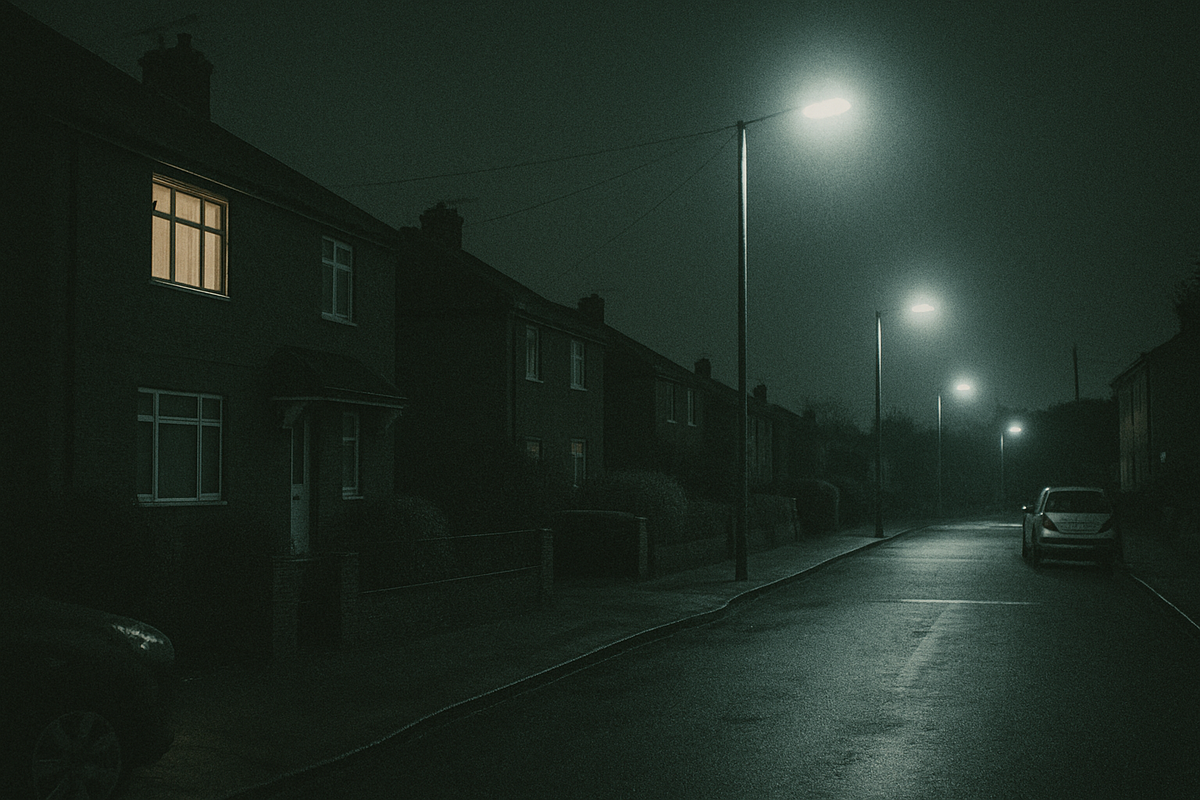
Cast your mind back a few years. The streetlights changed.
You remember it. One year the light on your road was that soft, warm orange — the colour of every childhood evening any of us ever had — and then, over a few grey weeks, a man in a hi-vis vest came round on a cherry-picker, and one by one the orange lamps went dark and hard white ones came on in their place. “Brighter,” they said. “More efficient.” “Better for the environment.” And you nodded, and you brought the washing in, and you thought about it for exactly as long as it took to think oh, they've done the lights — and then never again. Nobody thought about it again. That was the point.
Mark Steele thought about it. And I want you to notice what a rare and disciplined thing that is, because it is very easy to sneer at the man, and almost nobody alive has done the one thing he did, which is to stand beneath a brand-new streetlight and ask not “is it brighter?” but “why would they change the colour at all?” (he is here):
They were orange for a reason. You've got a Kelvin rate — it's a measure of brightness.
The reason why your orange lights were orange was to protect.
Orange for a reason. To protect. Sit with that. A council does not tear out a working, paid-for, perfectly good orange lamp and put a cold experimental white one in its place to shave a few pence off a bill. Mark knows it; half the country knows it in their bones and dares not say it. The old orange light — sodium, warm, narrow — sits in a dead, useless little corner of the spectrum. It carries nothing. The new white light does not. The white light is broad, and cold, and it sits exactly where a man would place a signal if what he wanted was not to help you see, but to reach you.
Because a light you can read a newspaper by is a side effect. That was never what the colour was for.
And here — here — is where Sabrina Wallace finishes Mark's sentence for him, from the far end of the country, without ever having heard the man's name. She understands what runs on a carrier like that, and she told us in four words, and they are four of the most precise words I have ever heard a human being utter (here):
It is pulsed and frequenced.
Pulsed. And frequenced. Do you see what she has just handed you? Those are not the ramblings of a woman who does not know what she means. Those are the two properties of a transmitter, named exactly. The white light is pulsed — it flickers far faster than your slow human eye can ever catch, so that to you it looks like nothing but a steady glow. And it is frequenced — tuned — and it is tuned, as I showed you last time, to you. To your number. To the address that Sabrina says you have been issued whether you ever asked for one or not.
That is the whole of it. That is the entire difference between the two bulbs. The orange one could not reach you. The white one can. They did not brighten your street. They tuned it.
Now stand back, and let the size of the thing arrive.
Every war you have ever watched on the news. Every election you were told was the most important of your life. Every headline they have ever waved in front of your face to keep your eyes up and busy. None of it — none of it — changed your actual life the way one bored man in a hi-vis vest changed it, on one forgotten grey Tuesday, when he unscrewed the orange bulb outside your bedroom window and screwed in the white one. That was the day. That was the coup. And it came with no tanks and no trumpets. It came on a works order. Filed under “street lighting — routine maintenance.” Approved by a sub-committee. Costed at a few pounds a unit, delivery included. The single most significant event of the century has a reference number and a signature at the bottom of it, and the man who signed it has almost certainly retired to the coast.
I have looked, and looked, and as far as I can discover I am the only living soul who has thought to draw a circle round it. The historians are all of them staring at the wrong century.
The light outside my own window changed on a Thursday. I remember it, because I remember everything — it is the affliction I have been given instead of sleep. I stood at the glass and I watched the orange go out for the very last time, and I did not yet know what I was watching, and if I have one regret in the whole of this business it is that I did not go down into the road that night and take the ladder out from under the man.
So do this, before you sleep. Go to your window. Look at the light on your street. Is it still orange? Then you have a little time yet, and you had better use it. Is it white? Then it has already begun, it began without your consent, and you are already on it — and the only question left to you is the one I put to myself every single night: now that you know, what are you going to do about it?
I know what I am doing about it.
More soon. Look up tonight.
— R.S.