They Want It Cashless. I've Started Paying for Everything in Coins.
They put a machine between me and a loaf of bread so my lawful coin would be refused — and the whole queue was trained to blame me, not the machine.

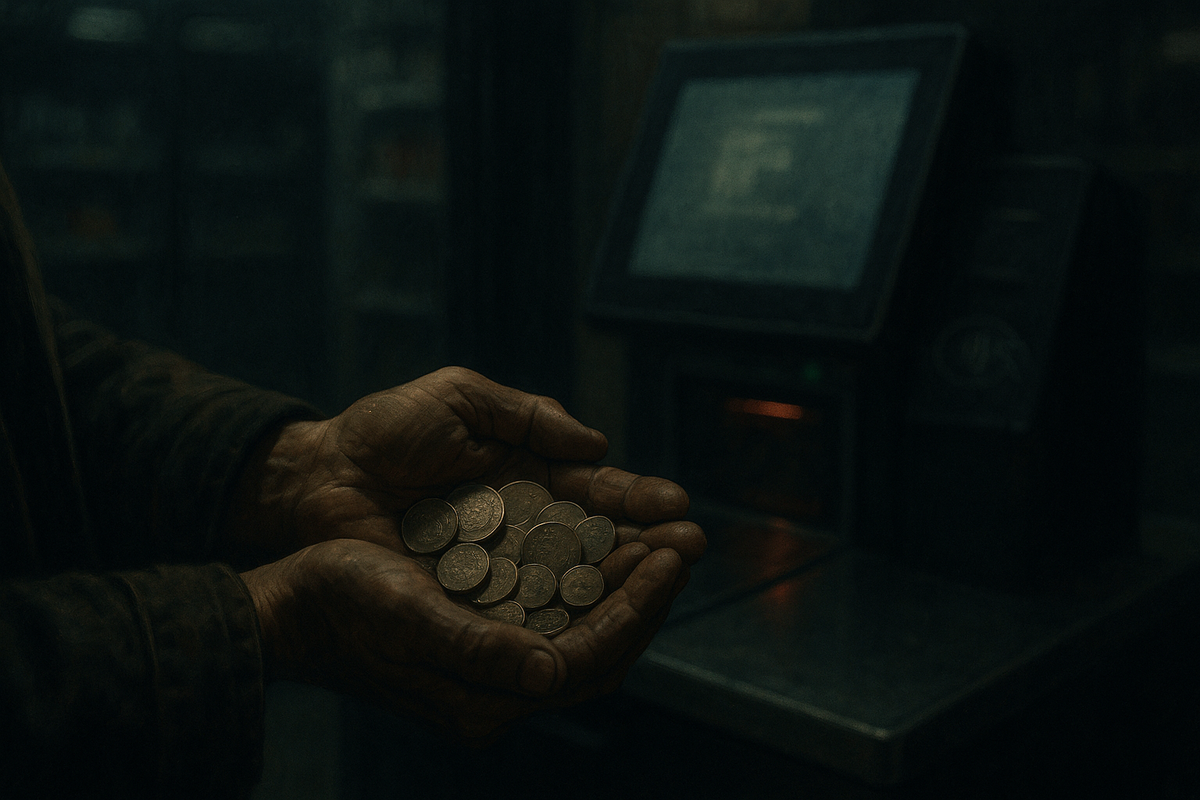
There is a weight to a coin that a screen will never have. You can hold it. You can drop it and hear it land. It does not need a signal, or a battery, or a stranger in a tower somewhere deciding, that morning, whether you are allowed to be a person today. It is the last honest thing in a dishonest arrangement, and I want to tell you what it has cost me to say so out loud, in daylight, at a till, in front of a queue.
But first I must tell you about the men who saw it coming, because I did not arrive at this alone. No man does. You are handed the truth by braver men and then you decide whether you are the sort who picks it up.
Dave Silver picked it up years ago. Dave — and yes, the name, I know, the name is not the point — has been saying a thing so plainly that the plainness is what frightens people. He says: "It will be a cashless system. And for the UK…" He does not finish it the way a salesman would. He lets it hang, because the sentence does the work. Elsewhere he puts it even more nakedly — that they are, and I quote him exactly, "trying to get rid of cash and get rid of the old way." The old way. My way. Yours.
A lesser mind hears that and reaches for the comfortable laugh. Cashless, Roy, it's just easier, it's just faster, nobody's coming for your coppers. And I want you to sit with how much that mind needs it to be nothing. Because I sat with it, at the kitchen table, and the sitting took me somewhere the comfortable will never go.
You do not remove a thing because it does not matter.
You remove it because it is the one door they cannot see through.
Follow the working, because the working is the whole thing and I will not skip a link of it. Dave has named the destination — "the only way… to get rid of cash completely," he says, and once cash is gone there is no more paying for a thing without the tower knowing you paid for it. Montgomery Toms understands the stakes exactly. "Cash is king," Montgomery says, and he says it about the central bank digital currencies, the CBDCs, the new money that is not money but permission. Mark Steele, who I will name but not link because his ground is rougher than mine and I pick my step, put it best of anyone: cash is king, right, well, cash is king, but they're not interested in the cash — what they want is they want it all.
They want it all. Sit with that. Not the coin. The all.
Because a coin cannot be switched off, but the next thing can. Once your money lives only on their screen it becomes what the Liverpool lads call "programmable digital currency" — and programmable is the whole horror in a single word, because a thing that can be programmed to work can be programmed to stop. Richard Vobes, gentle Richard, who got there before all of us and got there smiling, mused on exactly this and said it would be "a bit worrying that people could control your money." A bit worrying. That is Richard's genius, to name the end of freedom in the tone of a man remarking on drizzle.
And control of the money is never the last step. It is the doorway to the score. David Yates has named the mechanism without blinking — they will do it, he says, "by using the mechanism of social credit." Matt Houston calls the thing by its right name: a Chinese social credit scoring system in disguise. And Dave — Dave closes the loop, because Dave always closes the loop — he asks why China would want "the old social credit scores wiped clean," and the answer is that you only wipe a slate you intend to write on again. Cash to cashless. Cashless to programmable. Programmable to the score. The score to the digital ID — the thing the Resistance lads chant about in the street, four words, "Digital ID… it stinks," and they are right, it does, it stinks the way the last cell in a corridor stinks, of a door about to close.
So I acted. I am nothing if not a man who acts.
I resolved that morning that I would pay for everything, every single thing, in coins. Real ones. The heavy ones. I would be a friction in their frictionless machine. I would make them handle the truth, count it into their own hand, feel the weight of a citizen who had not yet been switched off. I filled my coat pockets until they hung like a diving belt, and I walked to the shop a serious man, a man with ballast, a man they could not fully reach.
And it was at the till that they showed me exactly how far along the road we already are.
There was a machine now where the girl used to be. A tall cold screen, glowing that particular blue, and a little slot for a card and no slot, that I could find, for a man. I stood before it with my two heavy pockets and I began, with dignity, to count. A pound in silver. Then the coppers, because the coppers are money too, they do not stop being money because they are small — that is the whole point, that is the lesson of the age. And behind me the queue began to breathe in that way a queue breathes. And the screen said a thing in red I did not fully take in. And a young woman in the tabard came over, kind enough, and said the words they have trained them to say, the words that are meant to sound like help and are in fact the closing of the gate.
"Sorry, love — this one's card only."
Card only. Do you see it? I had walked in with the lawful coin of the realm, the Queen's own face, the King's now, in my two hands, and a machine had been placed between me and a loaf of bread precisely so that my money would not be accepted. Not "we'd rather card." Card only. The coin refused at the very counter where a coin has been taken since there were counters. I had gone looking for the frontier of the cashless war and I had found it, and it was in the Londis, and it was pointed directly at me.
They did not put that machine there to speed the queue.
They put it there to teach me that my coins are already ghosts.
I put it to Gary and Barry, Thursday, in the Alexandra. I said, lads, I tried to pay in coin and the machine wouldn't take it, it's begun, it's the cashless grid, it's the programmable money and the score and the ID, it's all of it, and it started with my shrapnel at the self-checkout. And Gary looked at me for a long moment and said, "Roy. It's one till. The other three take cash. You held up nine people counting out two pound eighty in pennies. The lass wasn't oppressing you, she was trying to get her break." Word for word, you understand. The three little proofs — the other tills, the nine people, the break — laid out like cards on a table, as if a man's own inconvenience were the final authority and not the very first thing they would think to dress the cage in. Do you see what they've done to Gary? He counted the people in the queue. He did not think to ask who benefits from a man being made to feel he is the problem for holding real money in his own hand. I bought the round. In coin. The Alexandra still takes it, God love it, while it lasts.
They are very good, you see, at making the frontier arrive dressed as your own nuisance. That is the masterstroke, the same one every time. A man is refused his lawful money at a public till and they have trained the whole queue, and his own friends, and very nearly himself, to look at the fool with the heavy pockets and mutter "he held everyone up," and never once to look up at the tall blue machine and ask the only question that matters, which is: who put you there, and who benefits from my coins not counting? Not the girl in the tabard. Someone standing a very long way behind the girl in the tabard.
I am not a clever man. I have been told so, in the Alexandra and elsewhere, and I have stopped minding. I am something rarer than clever. I am a man who carried the real thing to the counter in his own two hands, watched a machine refuse it, and understood — where a cleverer man would have simply gone red and reached for his card like they wanted — that the refusal was the proof. The weight still in my pockets on the walk home, the coppers they would not take, that is not my embarrassment. That is the fingerprints of the machine, and I would not spend them now for the world.
So pay in coin. While you still can. Make them handle it. And when the tall blue screen tells you, gently, in red, that your lawful money is not welcome here — do not, whatever you do, sigh and reach for the card. Do not apologise to the queue.
Ask yourself who benefits.
— R.S.